
Why Your Brain Needs a Destination (Even a Tiny One)
The science behind why a specific, low-stakes goal makes it dramatically easier to leave the house — and what it means for anyone navigating anxiety.

Picture two versions of a Sunday afternoon. In the first, someone tells themselves, "I should really get outside today." In the second, they tell themselves, "I'm going to walk to that bakery on Elm Street and look at what they have in the window." Same person. Same anxiety. Vastly different likelihood of actually walking out the door.
This isn't coincidence, and it isn't willpower. It's neuroscience. The brain doesn't respond equally to all intentions, and understanding why can change the way we think about leaving home when leaving home feels hard.
The problem with open-ended plans
In chemistry, activation energy is the minimum amount of energy required to start a reaction. Without enough activation energy, nothing happens…no matter how good the ingredients are. You can have the best bread flour of the highest quality, but without yeast… no loaf of bread. Behavioral psychology borrows this concept to describe why even things we genuinely want to do often don't happen: the cost of getting started is too high.

The research
Studies on goal-setting consistently show that vague intentions ("I want to exercise more") are dramatically less effective than implementation intentions: plans with a specific when, where, and what. Psychologist Peter Gollwitzer's foundational research found that people who formed concrete "if-then" plans were two to three times more likely to follow through than those who simply had the goal.
"I should get outside" is a vague intention. It has no shape, no end point, no built-in success condition. The brain, faced with an uncertain path, defaults to the known: the couch, the screen, the familiar interior. When you're already managing anxiety, that default pull is even stronger. Vague plans don't just fail to motivate, they actively leave the door open for avoidance.
How a destination changes the brain's calculus
A specific destination does something quietly powerful: it converts an open-ended, anxiety-prone question ("What am I even going to do out there?") into a closed, answerable one ("Can I walk to the park bench on the corner?") That shift matters enormously to a nervous system scanning for threats.
Research on anxiety and uncertainty processing shows that the brain's threat-detection system (centered in the amygdala) responds more strongly to uncertain situations than to known ones, even when the known situation involves mild discomfort. Counterintuitively, knowing exactly where you're going and why, even if the destination is small, reduces the perceived danger of the outing.
"Uncertainty is the nervous system's least favorite condition. A concrete destination, even a humble one, transforms the unknown into the known."
A named destination also provides something psychologists call a "completion signal. A clear marker that tells the brain when the task is done. "Get outside" has no completion signal. "Reach that park bench" does. And the brain, it turns out, is highly motivated by legible finish lines.
The difference between a chore errand and an adventure destination
Not all destinations are created equal. There's a meaningful psychological difference between going somewhere because you have to (dropping off a package, picking up a prescription) and going somewhere because you've chosen it for its own sake. One activates obligation circuitry. The other (even if the destination is tiny) activates something closer to curiosity and anticipation.

Chore Errand:
Externally assigned
Success = task completion
Anxiety about efficiency
Mentally closed on arrival
Relief when finished
Adventure Destination:
Self-chosen, low stakes
Success = showing up
Curiosity is the compass
Mentally open on arrival
Possibility when finished
The errand gets you out of the house. The adventure destination gets you into the world. That distinction, subtle but real, affects how the nervous system processes the entire experience, and whether it files it under "stressful" or "survivable and maybe even good."
Real destinations, real results
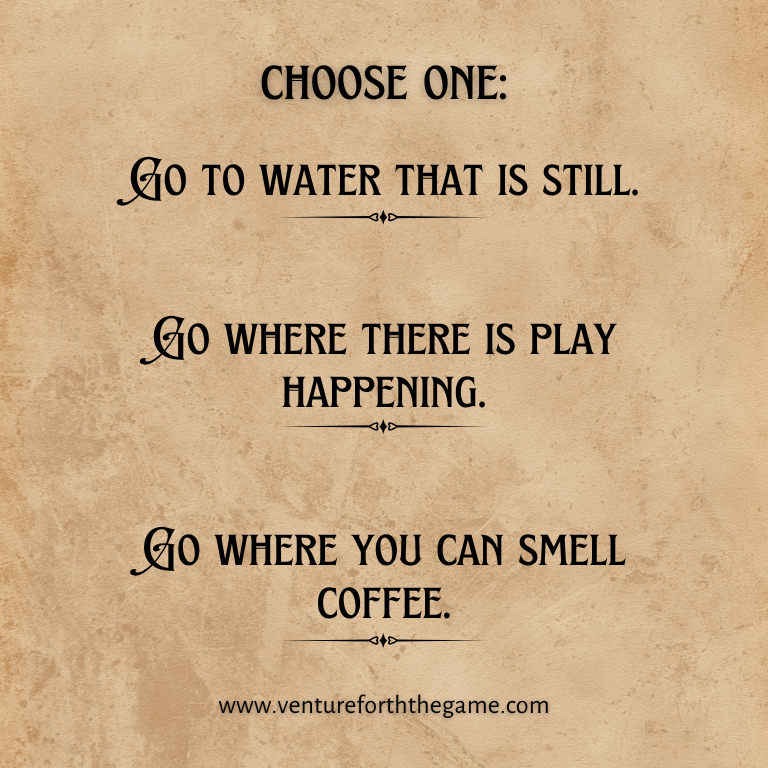
The destination doesn't need to be grand. In fact, the more ordinary, the better. Ordinary destinations feel genuinely achievable, which is the whole point. Even better? When a destination can be both ordinary, and “gamified.” If you can add an element of play or game, it makes your brain light up in all the right ways. That’s what I am attempting to provide with the Venture Forth Mail Club. Each month you get given 3 possible, achievable, real destinations – all open-ended enough to be interpreted by you no matter where you live, but also specific enough to get you to a real place.
Here are a few examples of what these destination" can look like in practice:
A place where there is running water.
A place with the smell of cinnamon.
Somewhere that looks out of place.
Each of these is concrete enough to eliminate the "what am I even doing?" cognitive overhead that so often derails outings before they begin. They're small enough that the anxiety math tips in favor of going. And they're interesting enough (chosen rather than assigned) to activate genuine curiosity rather than dread.
How the Destination card does this work for you
One of the things I thought hardest about when designing Venture Forth Mail Club was the question of friction. Even people who want to get outside regularly run into the same invisible wall: the moment of having to decide where to go, what to look for, what the point of it is. That moment of decision is exactly where anxiety likes to insert doubt.
The Destination card inside each Venture Forth envelope solves this elegantly and quietly. It hands you a ready-made, low-stakes destination; specific enough to follow, open-ended enough to feel like exploration rather than obligation. You don't have to plan the outing. You just have to pick up the card.
This is behavioral science made tangible. It's the implementation intention, the completion signal, and the curiosity prompt all packaged into something that arrives in your actual mailbox. The activation energy of going outside drops significantly when the "where" and "why" have already been handled for you.
And perhaps most importantly: the destination the card gives you is never a chore. It's always an adventure, even if it's just a bench, a bakery, or the corner of two streets you've walked past a hundred times without really seeing.
Ready for your next destination?
Join Venture Forth Mail Club
Each month, a thoughtfully curated envelope, including a Destination card, Object Card, Quest card, and more, arrives in your mailbox. Your brain gets the concrete goal it's been asking for. You get a reason to open the door and head out for a mild adventure!
The science is clear: your brain doesn't need a grand adventure. It needs a destination. Give it one, even a tiny one, and watch what opens up.

Roya Dedeaux is a Licensed Marriage and Family Therapist with a focus on using creative tools like art, writing, and recreation as a way to help teens and their families who don't quite fit the mold.
Roya is the author of Connect with Courage: practical ways to release fear and find joy in the places your kids take you, runs several art groups, and loves working both in her private and group practices! She is constantly creating new tools for more creatively, and even sells her original art on eBay under the name TheRecreative.
When she's not working she spends most of her time on a baseball field being a sportsball mama, and she loves to make messes with her three wild & wonderful kids where they live and play hard in Southern California.